



Italians often compliment my language skills when we first meet.
“Ammazza! Quanto bene parli l’italiano. Da quanto tempo vivi qua?” I hear versions of this all the time: “Wow! You speak Italian so well. How long have you lived here?”
Then I tell them I’ve lived in Rome for more than 25 years.
There’s usually a pause as they recalculate their compliments.
“Venticinque anni? Davvero? Dai, comunque parli benino” -- “Twenty-five years? Seriously? Well, anyway, your Italian’s not bad.”

Se fossi qui
By any reasonable measure, I speak fluent Italian. I work in Rome as a journalist, reporting for a variety of international news outlets. I appear as an analyst on Italian television. I give lectures. I read Italian-language books and articles. I conduct interviews on complex topics. I can strike the appropriate tone in an argument and imitate regional accents. I’ve even done stand-up comedy in Italian.
But my mistakes are fluent, too.
The roots of my grammatical weaknesses are easy to understand. When I moved to Rome, I immediately enrolled in a three-part, 12-week intensive language course. But six weeks in, I moved to an apartment farther from the school just as work started picking up. I dropped out, telling myself I’d probably return and that, in the meantime, I could learn the language simply by living in it.
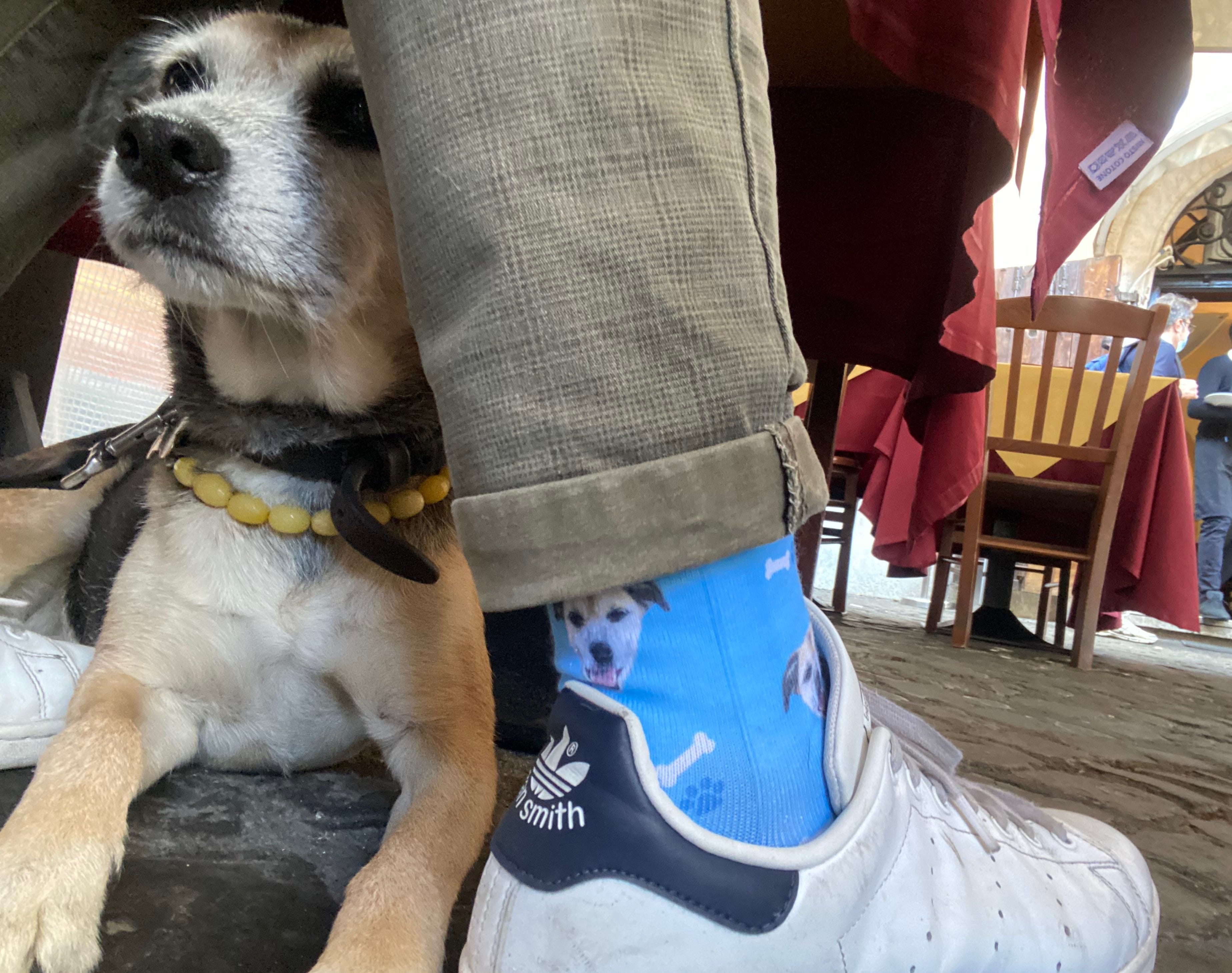
I still occasionally run into Sabina, my former Italian teacher and the owner of the school. We catch up on each other’s lives or discuss our shared love of dogs. One of us might remark on how quickly the years have passed or how much Rome has changed. And often, Sabina will politely comment about the state of my Italian skills.
“You speak very well,” she said when I called her in preparation for this essay. Sabina speaks good English, but we usually converse in Italian. “You have a tremendous vocabulary, and you speak with a lot of confidence. But ….”
Yes?
“But you still make mistakes with the conditional and the subjunctive,” she said. “For example, how would you say, ‘If you were here now’?”
“Se eri qui.”
“No, it should be ‘Se fossi qui.’”
And just like that, I was back in Sabina’s classroom, exactly where I’d left off more than 25 years ago.
Too kind to correct
I don’t think I was wrong to believe I’d learn Italian by living in it. My mistake was thinking it could teach me everything.
After I left the school, the language stopped being a topic I studied and became the setting for most of my life. I learned from newspapers and magazines, from conversations in coffee bars and dealings with Italian bureaucracy, from friendships, romantic relationships, work assignments, music, jokes, and misunderstanding unwritten rules.

The lesson: total immersion is an effective teacher, but it isn’t enough -- particularly in Italy, where native speakers are often too kind-hearted to correct someone who gets the broad strokes right.
And the subjunctive isn’t the only weak spot that has calcified for me. At least the subjunctive is famously difficult. I can speak knowledgeably about Garibaldi or Cicero or peculiarities of infrequently visited Roman neighborhoods. But I still get confused by a and in -- two of the language’s shortest words. For example: it’s a Roma, but in Italia; in Sicilia but a Malta. By the way, I had to look these up to make sure I got them right here.
There’s also a category of mistake I make only while speaking. How would I translate the phrase “I told her”? If I write it, I’ll get it right: le ho detto. But for some reason, while speaking I’ll take the clumsy, unnatural sounding way around: ho detto a lei (“I said to her”).
Nobody mistakes me for an Italian. But when I travel around Italy, people can tell by the way I speak that I’m a foreigner, but one who lives in the capital. I think that’s about the rhythm of the language and the expressions I use. I lean a lot on common, Roman-sounding filler phrases -- diciamo, in effetti, praticamente, comunque, alla fine, cioè, nel senso, boh -- but instead of using them like seasoning, I use them to buy time while a sentence is forming, often imprecisely, in my head.
Good enough
The trouble with fluency is that it removes the pressure to improve. I can make almost any point I need to make. I’ve spent 25 years speaking Italian well enough that nobody -- including me -- ever forced the issue.
I genuinely wish I’d studied more at the beginning. For her part, Sabina says she’s surprised I didn’t go back. She had always assumed I’d eventually return, if not to her school, then to somewhere else.
She tells me it’s not too late. She closed her school a few years ago, but she suggested I find a local tutor. Not simply a native speaker, she advised, but an experienced teacher: someone I can meet with regularly and whose job will be to interrupt me -- the one thing that, out of politeness, Rome refused to do for so long.
Until then, I’ll have to remember that, despite my fluency, I’m still only 25 years and six weeks into a 12-week course.

I’m Eric, author of The Italian Dispatch, a weekly newsletter about the version of Italy beyond the postcards: its culture, history, food, language, and everyday contradictions, all from the perspective of a veteran journalist in Rome. As a welcome to new readers, subscribers to one of Katarzyna’s newsletters can get two months of complete access to the Dispatch for the price of one, or 18 months for the price of a year, through Sept. 15. A paid subscription gets you the full archive of more than 60 essays, a monthly digest, and -- for annual subscribers -- a mailed gift package.
Never to late to improve our second or third... language skills.✌️🙂The majority of my actual students are 40/50+ ...they enthusiastically approach a second or a third or a fourth language and refine their skills.Bravissimi,no?
For you Eric will be the same, no stress, just fun and well structure lessons from a professional tracher.Only few lessons and you will be 🎶"Bravo, bravisssimo, bravo , bravissimo".🎶
“25 years and 6 weeks into a 12 week course…” This made me chuckle! I wonder what your former teacher, and other language experts, would say about the difficulty or relearning or fixing bad habits after such a long time.